


Or : 121 435,62€/kg   965,49 € 0,8%

 Argent : 1836,45€/kg   29,58 € 1,64%

Logo Goldreserve vector achat or en ligne
A physical relationship with your savings

Gold price today: follow the live price of gold

121 513 €Kilogram
+0,91 %+1 090 € today
120 000 €120 500 €121 000 €121 500 €122 000 €122 500 €09/09 02:2509/09 04:3909/09 06:5409/09 09:0909/09 11:2409/09 13:3909/09 15:5409/09 18:09
Updated 09/09 18:25Prices supplied by the Comptoir National de l’Or

Gold and precious metals price chart

This chart shows today’s gold price, in euros per kilogram, over the current day, and refreshes every five minutes. Because the price moves continuously, following it regularly tells you what your savings are worth and helps you spot the right moment to buy.

New to this? Read our advice on when to buy, or look through the history of the gold price over 1 year, 5 years and 10 years.

Why the four metals do not move at the same pace

Gold is the liveliest of the four, with a new reading every five minutes — close to three hundred over a full day. Silver publishes one every ten minutes, platinum and palladium every half hour. This is not a display choice but a reflection of how liquid each market is: gold is the most heavily traded precious metal in the world, while platinum and palladium are first and foremost industrial metals, with far smaller volumes. Our selling prices follow exactly the same cadence, metal by metal.

How the gold price is set

Unlike a share, gold is not traded on a central exchange with a single quotation. It changes hands over the counter, continuously, between banks and dealers, chiefly in London. The price therefore moves twenty-four hours a day on weekdays, transaction by transaction.

To provide a common reference all the same, the London market establishes a benchmark price twice a day, the LBMA Gold Price, at 10:30 and 15:00 London time. It is set by auction, administered by ICE Benchmark Administration, and underpins the vast majority of contracts worldwide. The benchmark is struck in dollars: the figures published in euros and in sterling are indicative only, intended for settling transactions.

Two factors then bear on what you pay in euros. The price is quoted in dollars per ounce, so a euro that strengthens against the dollar pushes the euro price down even when the dollar price has not moved. And the ounce used is not the ounce of everyday trade but the troy ounce, which weighs 31.1035 grams. A kilogram is therefore 32.1507 troy ounces, which explains the gap between the three units in the selector.

One point worth knowing when you compare with what you read elsewhere: financial websites most often display the gold futures contract, quoted in dollars per ounce. The price on this page is that of the physical metal in euros — the one that actually serves as the basis for calculating our selling prices.

Why a coin never costs the price of the metal it contains

This is the question that comes up most often, and the source of most misunderstandings. The price shown on this page is that of the raw metal. The price of a coin or a bar adds what is known as the premium: the cost of striking or casting it, the cost of checking and transporting it, and the scarcity of the object itself.

To work it out, start from the gross weight and the fineness. A 20 Francs Génie coin weighs 6.45 grams at a fineness of 900 thousandths: its metal content is therefore 6.45 multiplied by 0.900, or 5.805 grams. Multiply that figure by the price per gram shown above and you have the value of the metal the coin contains. The gap between that value and the selling price is the premium. The calculation can be repeated at any time, on any product page in our catalogue, and it is the surest way to check what you are buying.

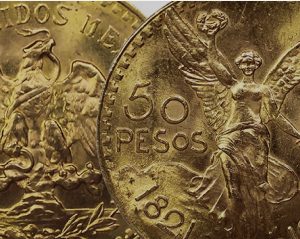
The premium is not the same everywhere, and two rules explain why. The first is size: the larger the coin or bar, the smaller the premium, because the cost of striking or casting, of checking and of transport is spread over more metal. Producing a five-gram minted bar and producing our one-kilogram cast bar takes comparable work, yet the second holds two hundred times more gold: the same fixed cost weighs two hundred times less on it. That is also why a heavy coin such as the Mexican 50 Pesos stays closer to the value of its metal than a tenth of an ounce does.

The second rule is the scarcity of the type. Bullion coins struck in their millions, such as the Napoleon 20 Francs or modern one-ounce coins, stay close to the value of their metal, because they are always available and their price depends on little more than the market. Older types struck in small numbers, or small denominations that have become hard to find, move well away from it: their price carries a scarcity the market price does not express. The 5 Francs Napoleon, which weighs only 1.61 grams, has the same fineness of 900 thousandths as a Napoleon 20 Francs, and yet its gap to the value of the metal is nothing like it.

These gaps are not arbitrary margins: they are fixed costs spread over very different quantities of metal, plus the real availability of each type. They have a practical consequence. If your aim is to hold metal as close as possible to the market price, large formats and common bullion coins are the most efficient. If you are looking for flexibility when you sell, small denominations change hands more easily, and that flexibility is paid for. The premium on any of our references can be worked out in seconds with the method above, from the price on its product page and the market price read on this one. Our guide on which gold bar to buy sets out this trade-off format by format, and our buying physical gold page takes the question from the point of view of a first-time buyer.

The price of 900-thousandths gold

A great many searches are for the price of « 900 thousandths » gold, because that is the fineness of the most widespread French coins: the Napoleon 20 Francs, the 10 Francs, the Mexican 50 Pesos and most of the Latin Union coinage. There is no separate price for that fineness. The quoted price is that of pure gold, and the value of an alloy is derived from it by multiplying by its fineness.

In practice, one gram of 900-thousandths alloy is worth 0.900 times the price per gram shown above. A Napoleon 20 Francs, which weighs 6.45 grams at that fineness, therefore contains the equivalent of 5.805 grams of metal. It is that value, and not the weight stamped on the coin, that serves as the basis for the calculation. The same reasoning holds for every fineness: 916 thousandths for a Sovereign or a Krugerrand, 986 for an Austrian Ducat, 999 for a bar or a modern one-ounce coin. Our article on the price of gold per gram walks through the calculation step by step, and the one on the Mexican 50 Pesos applies it to the heaviest coin in the catalogue.

Silver, platinum and palladium

The selector gives access to three other metals, which do not follow the same logic. Silver is far more volatile than gold, with swings from one reading to the next roughly twice as wide, because the market is narrower and a large share of demand is industrial. It too has its benchmark auction in London, at noon. Platinum and palladium are first of all metals of the car industry: their price depends more on vehicle production than on savings demand, and their trading volumes bear no comparison with gold.

One tax difference is worth knowing before you buy. Investment gold is exempt from VAT in France and across the European Union. The silver coins we offer are shown with no VAT added to their price, whereas the silver bar does carry it. If you hold French silver francs and are looking for their value, our article on French silver francs, Semeuse, Hercule and Turin answers that exact question.

What time frame to look at

One last remark, because it is often misunderstood. Watching the price minute by minute is of little use to anyone buying physical gold: the premium and the costs almost always amount to more than a single day’s movement. It is the table of changes above that is instructive: it places your purchase within an underlying trend, from the past week to the past decade.

Our prices are recalculated at every reading of the market, on every product page, with no manual intervention. You can therefore compare at any time the price of a coin shown in the shop with the price of the metal read on this page. And on the question of timing, as on the merits of spreading purchases out, our buying physical gold page sets out what we recommend.

Questions Fréquemment Posées

Once you have decided to invest in investment gold, it still has to be bought well. We suggest you:

  • Find a dealer you can trust: look into them, read the reviews, and check that the intermediary is sound
  • Spread your purchases over time: for large amounts it is generally wise to split them up, monthly or quarterly, so that swings in the price have less effect on your entry price.
  • Split your holdings: rather than buying one 500 gram minted bar, buy two of 250 grams or five of 100 grams. That way, if you need cash, you are not forced to sell the lot.
  • Protect the coins you buy with a sealed case, which also lets you opt, when you sell, for the most favourable tax treatment.

Always check that the site you plan to buy gold from is a dealer you can trust. A few things are worth checking:

  • The company is properly registered, with a physical address, ideally in France if you are buying from France
  • The dealer can be reached by telephone and by email
  • The goods you buy are insured and carried securely by a specialist carrier

Be wary of any seller who pushes you to invest through tactics such as emails posing as your bank, claims of zero risk or tempting promises

Buying gold in cash is forbidden in France and every transaction must be declared. Proof of identity is required. Steer clear of intermediaries who offer to get around this.

GoldReserve has its head office in Paris and its logistics centre in Strasbourg. Every shipment is insured and secured, through cover we take out on top of our carrier’s own insurance.

Gold is traditionally seen as a safe haven in times of economic, financial or geopolitical crisis. Many investors hold gold and use it to spread their holdings.

At Gold Reserve, we put that down to four basic qualities of the metal:

  1. Gold is universal. Everyone knows what gold is and that it is precious, and that idea has been rooted in culture for generations, at least as long as there are children’s stories with chests full of gold coins
  2. Gold is timeless: beyond the fact that it does not degrade, gold rests on more than two thousand years of history, through wars, revolutions and epidemics, holding its value over the long run.
  3. gold is a real asset, tangible and easy to carry. It cannot be synthesised and, by definition, exists on earth in a finite quantity.
  4. Gold is a neutral asset. It is nobody’s liability or debt, so it cannot go bankrupt the way a company or a state can. No authority controls it, unlike a currency, and its value is set freely by supply and demand.

One caveat: a safe haven does not mean absolute safety. The gold price can move significantly, up as well as down.

Each product has its own advantages, depending on what you are after:

  • Gold bars and minted bars are excellent savings products. They are 999 fine and carry a unique serial number that attests to their authenticity.
  • Gold coins struck after 1800, such as the Napoléon, let you put in a few hundred euros just as easily as several thousand, and are generally 900 fine. They also make a fine gift for family occasions.
  • Collector coins carry high premiums according to their rarity, whether from their effigy or a small mintage. They are the delight of numismatists and specialists, and are equally within reach of buyers looking for something out of the ordinary

GoldReserve offers all of these and will guide you through the purchase. Get in touch to talk it over.

Investment gold benefits from a favourable tax regime in France.

On purchase, investment gold is exempt from tax.

While it is held, gold generates no income, so it is not taxed. Nor does it fall within the scope of the French wealth tax on property, the IFI.

On sale, there is a choice of two regimes:

  • The flat-rate tax on precious metals (TMP) of 11.5% on the sale amount. Simple, though not always the better choice
  • The capital gains tax (TPV): the gain is worked out, then taxed at 19% for income tax and subject to social levies of 17.2%, a combined rate of 36.2%.

This capital gains regime also brings an allowance of 5% for each year held from the third year onwards, which means full exemption after 22 years.

Gold Reserve provides an invoice with every purchase carrying the information needed to opt for whichever tax regime the customer prefers. These rules apply to buyers who are taxed in France; if you are taxed elsewhere, your own country’s rules apply.

GoldReserve specialises in the sale of investment gold and silver through its website.

Founded in 2017, the company belongs to the Comptoir National de l’Or group which, with close to 100 branches, is one of the foremost French dealers in precious metals. Since the group was established in Alsace in 1976, more than 500,000 customers have relied on the professionalism and experience of this family-run business.

GoldReserve attaches the highest importance to the security of transactions and of personal data. The company complies with anti-money-laundering rules and works with leading counterparties who are themselves supervised. It takes every measure needed to ensure reliable and secure storage and delivery.

Blog

Latest gold and silver news

French silver coins: 50 Francs Hercule, 100 Francs, 5 Francs Semeuse and 20 Francs Turin on a black background

What are French silver francs worth? Semeuse, Hercule, Turin, 100 Francs

Many French households keep a few silver coins without quite knowing what they are. A Semeuse found in a drawer, an Hercule inherited from a grandfather, a hundred-franc commemorative bought at the post office in the nineties. These coins have one thing in common: they contain silver metal, and that silver has a value that can be calculated. Here is how to recognise the main French series, what determines their price, and what you can do with them depending on whether you want to buy them or part with yours. Recognising your coin France struck circulating silver coins until 1980, then commemoratives until the changeover to the euro. Four families cover almost everything that trades on the metal market today. To identify yours, two pieces of information are nearly always enough: the face value written on the coin, and the diameter measured with a ruler. The 5 Francs Semeuse Struck from 1959 to 1969, the 5 Francs Semeuse is the most widespread of the French silver coins. It weighs 12 grams at a fineness of 835 thousandths, with a diameter of 29 millimetres. Oscar Roty’s design, a sower walking into the wind, is the same one later carried over onto the French euro coins. It is often the first silver coin people come across, and its very wide circulation explains why it trades close to the value of its metal. One point must be checked before anything else, and it is the most common confusion on this coin: only the years from 1959 to 1969 contain silver. From 1970 until 2001 the Semeuse carried on being struck with exactly the same design, but in nickel. Those coins have no metal value at all. The design tells you nothing; the year settles it. The 10 and 50 Francs Hercule Augustin Dupré’s Hercules group, two figures flanking a central character, appears on two quite distinct coins. The 10 Francs Hercule, struck from 1964 to 1973, weighs 25 grams at 900 thousandths with a diameter of 37 millimetres. The 50 Francs Hercule, struck from 1974 to 1980, is markedly more imposing: 30 grams at the same fineness, for 41 millimetres. It is the largest circulating silver coin France produced in the twentieth century, and the one that comes up most often in searches. The two are told apart at a glance by size, and beyond doubt by face value. Here the year of issue holds fewer traps than on the Semeuse: the ten-franc coin changed design after 1973, and the fifty-franc coin was no longer struck after 1980. An Hercule is therefore an Hercule, and it contains silver. The 10 and 20 Francs Turin Designed by Pierre Turin and struck from 1929 to 1939, these two coins are recognisable by the head of a woman wearing a helmet of wheat ears. The 10 Francs Turin weighs 10 grams for 28 millimetres, the 20 Francs Turin weighs 20 grams for 35 millimetres. Both are struck at 680 thousandths, an appreciably poorer alloy than the Hercule. This is a point many people miss: at equal weight, a Turin contains noticeably less silver than a Semeuse or an Hercule, and therefore trades at a lower price. Here too the design outlived the metal, and it is worth knowing before rejoicing. Only the years from 1929 to 1939 are silver. The 10 Francs Turin was struck again after the war in cupronickel, from 1945 to 1947 and then from 1947 to 1949, with the same helmeted face and no metal value. The 100 Francs in silver After circulating silver coins were discontinued, the Monnaie de Paris carried on striking 100 Francs in silver from 1982 to 2001, first in the Panthéon type and then as a long series of commemoratives. They weigh 15 grams at 900 thousandths, for a diameter of 31 millimetres. These are the coins most often found in gift sets bought at the time, sometimes still in their blister packs. What makes a silver coin worth what it is worth The price of an ordinary silver coin is built on a simple basis: the quantity of silver it contains, multiplied by the rate of the moment. That quantity follows from two figures printed in the coin’s specifications, its gross weight and its fineness in thousandths. A 50 Francs Hercule of 30 grams at 900 thousandths contains far more metal than a 10 Francs Turin of 10 grams at 680 thousandths, and that gap alone explains most of the price difference between them. The silver rate itself moves continuously on international markets. You can follow it on our gold and silver price page. A coin that was worth a certain amount six months ago may be worth appreciably more or less today without the coin having changed at all: it is the metal that moved. Beyond the metal, two things adjust the price at the margin. First the state of preservation: a heavily worn, scratched or badly cleaned coin loses some of its appeal, without ever falling below the value of its silver. Then the year of issue: some years were struck in smaller numbers, which can attract additional interest from collectors. It is worth staying measured on this point. For the vast majority of Semeuse, Hercule and hundred-franc commemoratives, these coins were produced in very large numbers, and it really is the metal that sets the price. Believing otherwise is the most frequent source of disappointment among people having a family collection appraised. Buying French silver francs Silver francs are an accessible way into physical metal. A coin costs a few tens of euros depending on the format and the rate, which lets you start without committing a large sum and build up a holding you can release in small quantities. That is a flexibility a bar does not offer. Our silver range gathers these French coins alongside the international one-ounce formats. Displayed prices are recalculated continuously from the rate, so what you see on screen matches the market of the moment. A

Read more »
Logo Goldreserve vector achat or en ligne

Gold today, per kilogram

First price of the day120,422.80 €
High of the day122,447.70 €
Low of the day120,116.90 €
Change today+0.91 % +1,090 €
Gold over the longer term, per kilogram
PeriodChangeLowHigh
7 days+0.8 %120,526 €123,689 €
1 month+0.6 %120,526 €127,746 €
3 months+6.4 %112,163 €127,746 €
6 months−14.7 %112,163 €142,400 €
1 year+21.8 %99,732 €148,274 €
5 years+148.8 %47,899 €148,274 €
10 years+219.7 %33,033 €148,274 €

High and low recorded over the period, in current euros, with no adjustment for inflation. Changes are measured from the first quoted price of each period.